
Japanese Transcription Accuracy, Measured: Whisper vs MAI-Transcribe-2
Try ShortClip for free.
Upload a video and ShortClip finds the key scenes, makes them vertical, and adds captions and a title.
Make short videos for free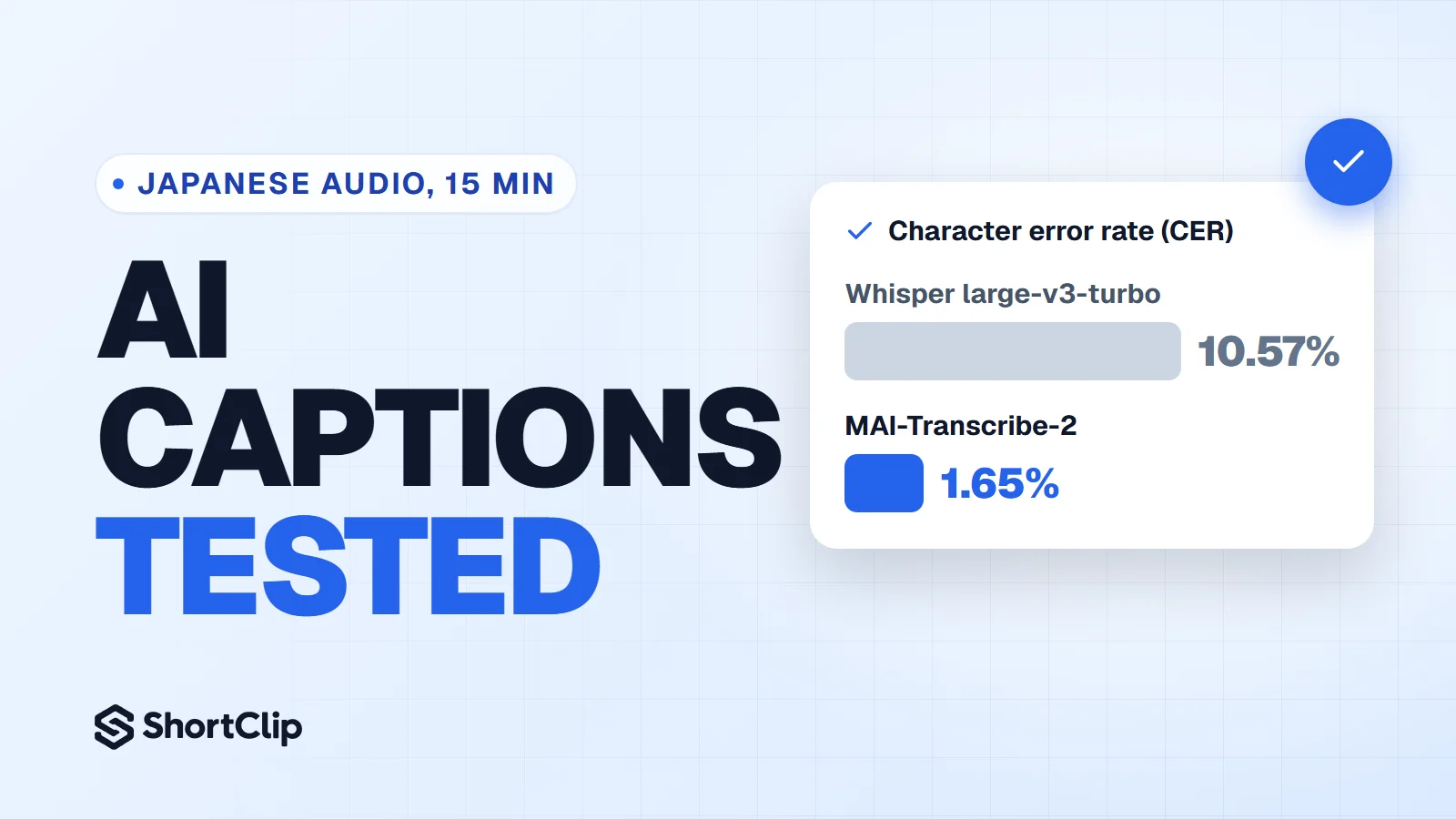
Character error rate, proper nouns and the error types that matter for Japanese captions, measured on public audio with a human reference.
What we measured
Caption tools often claim "97%" or "99%" accuracy without saying which audio, which language or what counted as correct. For Japanese that number matters even more, because Japanese has no spaces between words and word error rate (WER) is hard to define. We used public Japanese audio that comes with a human reference transcript and counted every character that differed.
| Item | Details |
|---|---|
| Audio | 13 clips from Google FLEURS (Japanese test split), about 15 minutes in total, read aloud by native speakers |
| Reference | The human-written source text shipped with the data set (3,511 characters) |
| Models | Whisper large-v3-turbo (Groq API, language=ja) and MAI-Transcribe-2 (Microsoft Azure, verbatim) |
| Audio format | 16 kHz mono 64 kbps MP3, the same file for both models |
| Post-processing | None: no LLM correction, no filler removal, no kanji/kana conversion |
| Scoring | Unicode NFKC normalisation, then spaces, punctuation and symbols removed before a character-level comparison |
ShortClip uses MAI-Transcribe-2 for Japanese transcription. This comparison was run before we chose it.
Results
| Metric | Whisper large-v3-turbo | MAI-Transcribe-2 |
|---|---|---|
| Character error rate (CER) | 10.57% | 1.65% |
| Substitutions | 139 characters | 45 characters |
| Deletions | 176 characters | 9 characters |
| Insertions | 56 characters | 4 characters |
| Proper nouns wrong (of 64) | 18 | 7 |
| Processing time (15 min of audio) | 11.3 s | 30.1 s |
Whisper had more deletions than substitutions: its error rate is driven less by misheard characters than by stretches of speech that produced no text at all. It was also about 2.7 times faster, so the right model depends on whether speed or accuracy matters more for the job.
| Clip | Seconds | Reference chars | Whisper | MAI |
|---|---|---|---|---|
| s01 | 73.4 | 301 | 4.32% | 1.33% |
| s02 | 66.7 | 310 | 2.90% | 1.29% |
| s03 | 70.3 | 300 | 11.33% | 1.67% |
| s04 | 61.5 | 257 | 15.18% | 1.95% |
| s05 | 70.0 | 268 | 3.73% | 0.75% |
| s06 | 73.2 | 260 | 3.46% | 1.15% |
| s07 | 78.2 | 347 | 34.58% | 1.15% |
| s08 | 71.4 | 227 | 4.41% | 3.96% |
| s09 | 72.8 | 240 | 29.58% | 0.83% |
| s10 | 62.4 | 253 | 4.74% | 1.98% |
| s11 | 64.7 | 245 | 8.16% | 2.86% |
| s12 | 75.2 | 244 | 1.64% | 0.41% |
| s13 | 77.0 | 259 | 7.72% | 2.70% |
Whisper stayed under 5% on 9 of the 13 clips. Three clips (s07, s09 and s04) pull the average up, and they show the error types worth knowing about.
The kinds of errors we saw
| Type | Example | Effect on captions |
|---|---|---|
| Missing sentence | s07 and s09: one full sentence never appears in the Whisper output | Large: the speaker talks with no caption on screen |
| Words nobody said | s07: Whisper wrote "thank you very much" where the missing sentence should be | Large: the caption shows words that were never spoken |
| Repeated sentence | s04: Whisper repeats most of the last sentence | Medium: counted as insertions |
| Wrong homophone | Whisper: "trader" became "ministry of trade", "extortion" became "strengthening", "ballot box" became "ballot frame". MAI: "multilateral" became "other-country" | Medium: readable, but the meaning changes |
| Broken proper noun | Whisper: Kennedy became "Keneri", Johnson became "Joson". MAI: Kundalini became "Kundadini". Both: Dar al-Badia became "Darrubaria" | Medium: viewers notice at once |
Both models get names wrong
| Whisper large-v3-turbo | MAI-Transcribe-2 | |
|---|---|---|
| Correct | 46 (71.9%) | 57 (89.1%) |
| Wrong | 18 | 7 |
| Examples of wrong names | Bangladesh, Galapagos, Buenos Aires, Kennedy, Lyndon Johnson, Texas, Belarus | Bangladesh, Uppsala, Katrina, Kirchner, Schwarzenegger, Riga |
Even the more accurate model broke about one name in ten. Spelling variants counted as errors here, so some of these would still be readable, but names of people, products and channels should always be checked by a person.
What to check in short-video captions
The read speech in this test ran at about 230 Japanese characters per minute, so a 60-second short carries roughly 200 to 300 characters of captions. At 2% CER that is a handful of fixes; at 10% it is 20 to 30. Check in this order:
- No stretch of speech without a caption (a missing sentence)
- No words that were never said, especially after silence or a pause
- Names of people, places, products and channels
- Numbers, dates and amounts
- Homophones that change the meaning
To fix captions in ShortClip, see how to edit AI captions. For choosing a caption tool, see our comparison of AI subtitle tools and the guide to transcribing video.
What this test does not tell you
- The audio is read speech. Fast conversation, laughter, gaming commentary and people talking over each other are not included; real talk videos will score worse with both models.
- About 15 minutes in 13 clips is enough to see a large gap between the models, not to rank differences under 1%.
- Models change. These results are from October 19, 2026.
- Punctuation was removed before scoring, so punctuation and line breaks, which also affect readability, are not compared.
How to test a tool on your own videos
Pick 1 to 3 minutes
Choose a typical stretch with names or jargon in it.
Write the reference yourself
Type exactly what is said. Keep or drop fillers to match the tools you compare.
Run the same audio through each tool
Use the same file every time, or the results are not comparable.
Count what you had to change
Characters changed divided by reference length gives CER. If that is too much work, counting fixes and missing sentences is enough to compare tools.
Data and sources
Audio and reference text: Google FLEURS (Japanese, ja_jp test split). Conneau et al., "FLEURS: Few-shot Learning Evaluation of Universal Representations of Speech" (arXiv:2205.12446). Licensed under CC BY 4.0 (https://creativecommons.org/licenses/by/4.0/). The examples above are translated from the data set's reference text.
Costs are estimates from public list prices (Whisper large-v3-turbo $0.04 per audio hour; MAI-Transcribe-2 calculated at $0.54 per hour, while Microsoft lists an introductory non-streaming price of $0.10). The whole run cost about $0.15.
See plans and pricing|Free plan: up to 60 minutes a month, no credit card required
Related guides
How to transcribe a video automatically: 7 free AI tools compared (2026)
How automatic transcription works, the free tools worth trying, and how to turn a transcript into short videos.
Best AI subtitle generators: 3 types of tools and how to choose
AI subtitle tools come in three types. Here is what each does well and how to pick one for your videos.
How to edit AI captions: text, timing, and design
Fix typos in AI captions, match their timing, and set the font and colors. Every caption edit in one guide.